


Many English learners often wonder: Do I sound fluent in English? The truth is, fluency is not always easy to measure. Someone may speak English confidently in daily conversations but still struggle with academic discussions, professional communication, or advanced vocabulary.
To make this evaluation fair and consistent worldwide, experts use the Common European Framework of Reference for Languages (CEFR). CEFR is a global standard that categorizes language skills from beginner to mastery. Alongside this, the IELTS test is one of the world's most widely recognised English language tests and is commonly linked to CEFR levels. This comparison helps universities, employers, and immigration authorities more easily assess a candidate's English proficiency.
In this guide, you will learn:
- What CEFR is and why it matters
- How CEFR levels are structured
- How IELTS band scores match CEFR levels
- What skills are expected at each stage
By the end, you’ll have a clear picture of how your IELTS score reflects your place on the CEFR scale and what that means for your academic, professional, and personal growth.
What is CEFR?
The Common European Framework of Reference for Languages (CEFR) is a standardized framework developed by the Council of Europe to describe language ability. It provides a common scale that can be used across different languages and examinations.
The CEFR divides language proficiency into six levels:
- A1 – Beginner
- A2 – Elementary
- B1 – Intermediate
- B2 – Upper Intermediate
- C1 – Advanced
- C2 – Proficiency/Mastery
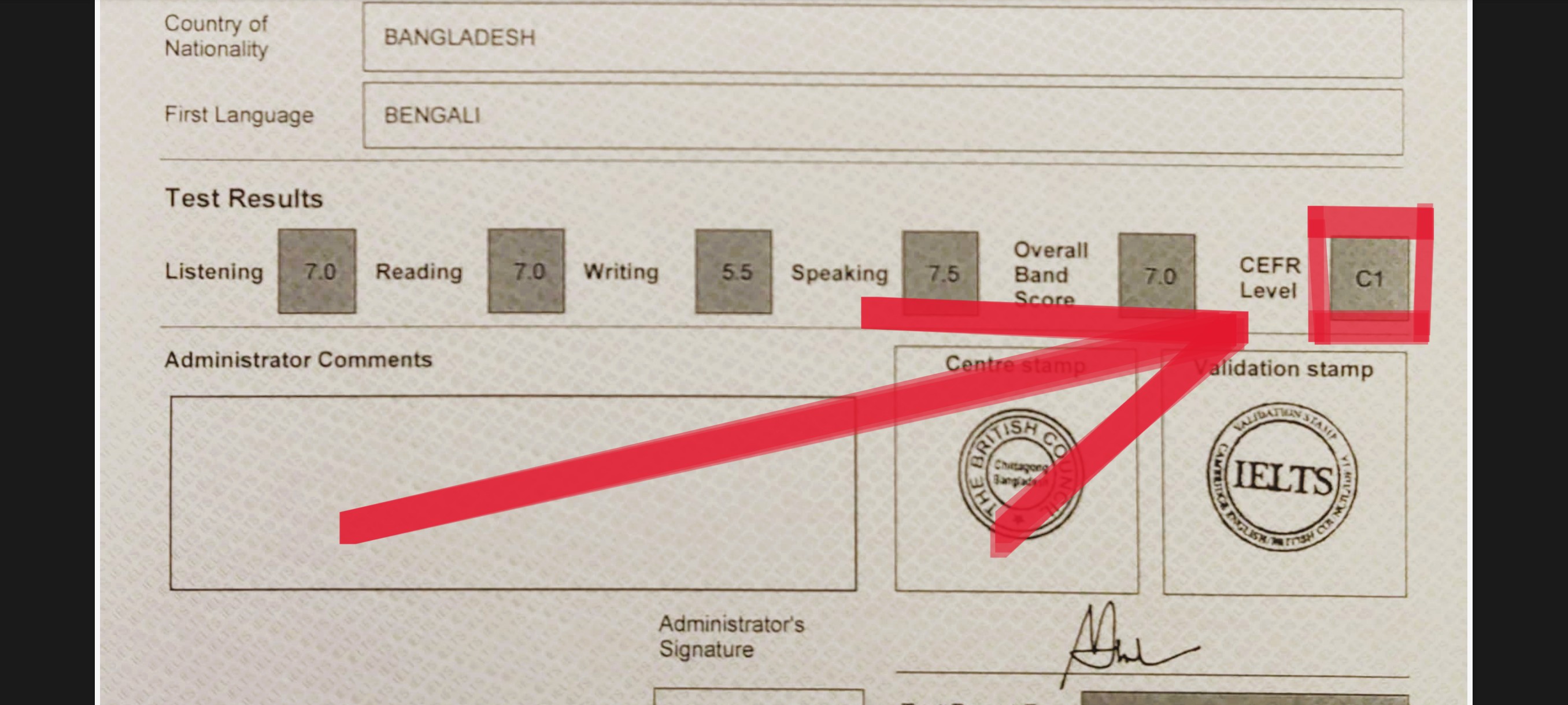
These levels measure how effectively a learner can understand, speak, read, and write in real-life situations. Although IELTS does not officially issue CEFR levels on score reports, many institutions use IELTS-to-CEFR equivalency charts to understand a candidate's proficiency level.
How are CEFR Levels Categorized?
The CEFR framework is divided into three broad categories:
Basic User
Level A1 is for identifying beginners, and Level A2 is for the elementary level. In these levels, learners can understand and use simple everyday expressions and basic phrases.
Independent User
Reaching Level B1 (Intermediate) or B2 (Upper Intermediate) shows that the candidate can communicate independently in most social, academic, and workplace situations.
Proficient User
Getting Level C1 (Advanced) or C2 (Mastery) signifies that the learners can communicate effectively in complex academic, professional, and social environments with a high degree of accuracy and fluency.
What is the connection between IELTS Band Scores & CEFR Levels?
The following table shows the commonly accepted equivalency between IELTS band scores and CEFR levels:
| CEFR Level | IELTS Band Score |
| A1 | Below 3.0 |
| A2 | 3.0 – 3.5 |
| B1 | 4.0 – 5.0 |
| B2 | 5.5 – 6.5 |
| C1 | 7.0 – 8.0 |
| C2 | 8.5 – 9.0 |
These equivalencies are widely used by educational institutions and language professionals to estimate English proficiency.
Each CEFR Level Explained
The CEFR has six English levels, from A1 (Beginner) to C2 (Proficient). Each level shows what a learner can understand, say, read, and write in English. It provides a simple way to measure English language skills and track progress over time.
CEFR A1 – Beginner
At the A1 level, learners can use familiar everyday expressions and basic phrases. They can introduce themselves, ask simple questions, and understand very basic conversations.
What an A1 learner can do:
- Introduce themselves
- Talk about family and personal details
- Understand simple instructions
- Use common everyday vocabulary
Example sentence:
"Hello. My name is Rahim. I live in Dhaka, and I am a student."
CEFR A2 – Elementary
A2 learners can communicate in simple routine situations involving familiar topics.
What an A2 learner can do:
- Describe daily activities
- Discuss shopping and travel
- Understand frequently used expressions
- Write simple messages
Example sentence:
"I usually go to work by bus. On weekends, I like visiting my friends and watching movies."
CEFR B1 – Intermediate
At the B1 level, learners become independent users of English. They can handle most travel, work, and social situations.
What a B1 learner can do:
- Describe experiences and plans
- Explain opinions
- Write connected text
- Participate in everyday discussions
Example sentence:
"I was disappointed when I failed my driving test, but I am planning to take it again next month."
CEFR B2 – Upper Intermediate
B2 learners can communicate with fluency and spontaneity. They can discuss abstract topics and understand more complex texts.
What a B2 learner can do:
- Participate actively in discussions
- Understand detailed texts
- Present arguments logically
- Communicate effectively in professional settings
Example sentence:
"Although the project faced several challenges, the team successfully completed it ahead of schedule."
CEFR C1 – Advanced
C1 learners can use English effectively in academic and professional environments. They have a strong command of vocabulary and grammar.
What a C1 learner can do:
- Understand demanding texts
- Express ideas fluently
- Use advanced vocabulary accurately
- Produce well-structured written content
Example sentence:
"The government implemented several measures to mitigate the economic impact of the crisis."
Words such as concise, inevitable, exacerbate, and mitigate are commonly understood and used at this level.
CEFR C2 – Proficiency/Mastery
C2 represents near-native proficiency. Learners can understand virtually everything they hear or read and express themselves precisely in any context.
What a C2 learner can do:
- Understand subtle meanings
- Use sophisticated vocabulary
- Communicate effortlessly
- Adapt language for different audiences
Example sentence:
"The ephemeral nature of social media trends makes it difficult for brands to maintain long-term consumer engagement." Advanced vocabulary such as ephemeral, mollify, cacophony, and indolent often appears at this level.
Why CEFR Matters for IELTS givers?
Understanding CEFR levels helps IELTS candidates identify their current proficiency and estimate the band score they may achieve.
For example:
- Students at the A2 level often struggle to score above IELTS Band 4.
- Students at the B1 level typically target Band 5.
- Students at the B2 level often achieve Band 6 to 6.5.
- Students at the C1 level commonly score Band 7 or higher.
- Students approaching C2 proficiency may achieve Band 8.5 to 9.
By understanding CEFR levels, you can create realistic study plans and focus on the vocabulary, grammar, reading, writing, listening, and speaking skills needed for their required band score.
Final Thoughts
Fluency and proficiency are not the same. A person may speak English fluently in everyday situations while still lacking the advanced vocabulary, precision, and academic communication skills expected at higher CEFR levels.
The CEFR framework provides a clear roadmap from beginner to mastery. Whether your goal is IELTS Band 6.5 for university admission or Band 8+ for competitive academic or professional opportunities, determining CEFR levels can help you measure your progress and identify the next stage of your English learning journey.
At MIE English Academy, starting for IELTS preparation journey begins with understanding your CEFR level, your key to achieving the target band score and opening the scope to worldwide opportunities in education, careers, and migration.
Frequently Asked Questions (FAQs)
1. What does CEFR stand for?
Ans: CEFR stands for Common European Framework of Reference for Languages.
2. How many CEFR levels are there?
Ans: There are six levels: A1, A2, B1, B2, C1, and C2.
3. Is CEFR officially included in IELTS results?
Ans: IELTS Certificate also indicates your CEFR Level.
4. What CEFR level is IELTS Band 6?
Ans: IELTS Band 6 is generally considered equivalent to CEFR B2.
5. What CEFR level is IELTS Band 7?
Ans: IELTS Band 7 is generally equivalent to CEFR C1.
6. Is C2 higher than IELTS Band 8?
Ans: C2 roughly corresponds to IELTS Band 8.5–9.0.
7. Which CEFR level is required for studying abroad?
Ans: Most universities require B2 or C1 level proficiency.
8. Can a beginner achieve C1 level?
Ans: Yes, with consistent study and practice over time.
9. Why is CEFR important for IELTS preparation?
Ans: It helps learners understand their current level and target score requirements.
10. What is the highest CEFR level?
Ans: C2 is the highest level and represents mastery of the language.